CPV - Automated Continuous Process Verification Software for Biomanufacturing
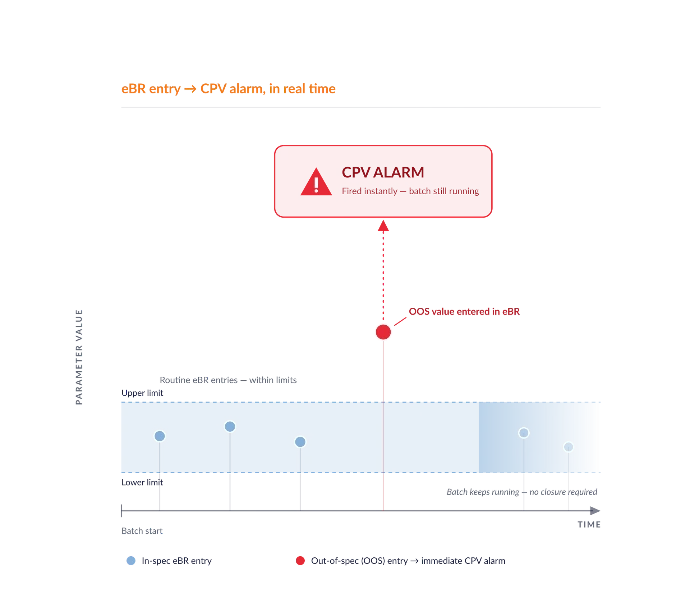
The CPV module of Hercule monitors every critical parameter in real time — and fires an OOS alarm the moment a running batch goes out of specification, not after it closes.
Book a 45-minute call — we'll map one of your processes with you
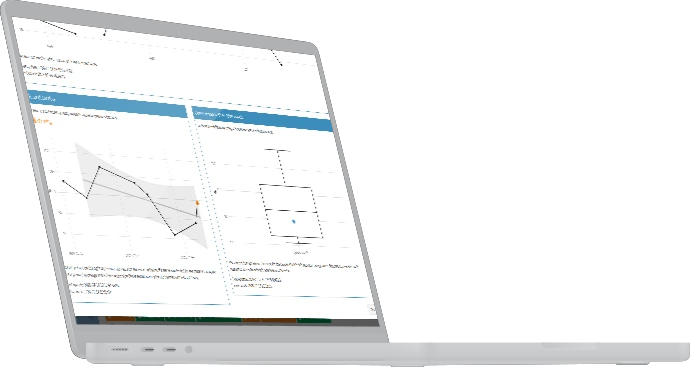

What is Continued Process Verification in biomanufacturing?
Continued Process Verification (CPV) is the third stage of the FDA and EMA process validation lifecycle (ICH Q10, FDA Guidance 2011). It requires manufacturers to maintain ongoing assurance — backed by collected data — that a process remains in a state of control during routine production. In biomanufacturing, CPV is not optional: it is a regulatory expectation for every commercial biologics or cell therapy process. The challenge is execution: most organisations still run CPV from exported spreadsheets, quarterly, on batches that have already closed. Hercule makes CPV continuous, automated, and structurally connected to your batch records.
How Hercule CPV works — from setup to live monitoring
1
Map your process
in ISA S88
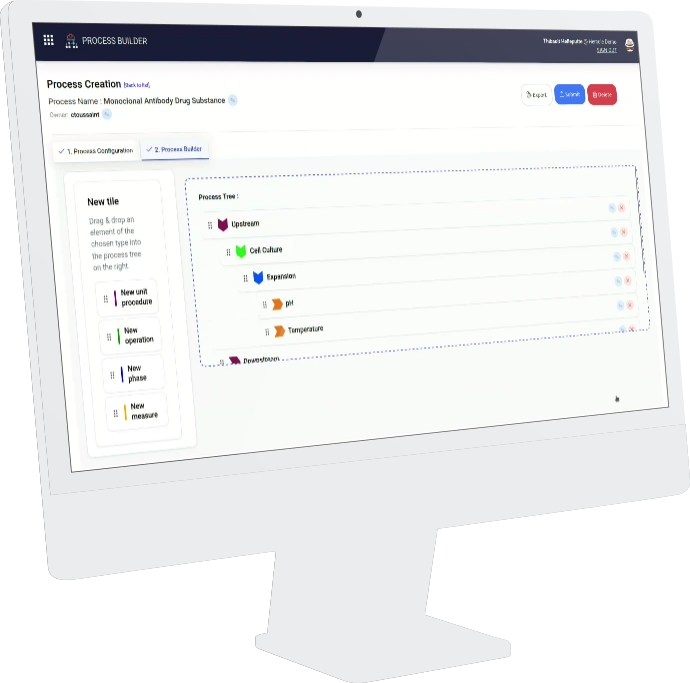
Use Hercule's Process Builder to encode your process structure — unit operations, equipment, parameters — in an ISA S88-compliant hierarchy. If you already have a CPV strategy document, your process is already described: re-encoding it takes days, not months. Every parameter is typed at capture as CPP, CQA, or actionable — no post-hoc classification.
2
Connect your existing data sources — read-only
Hercule connects to your LIMS, ERP, SCADA, EMS, and historian via read-only connectors. Nothing is written back to source systems. Data from all silos flows into the Hercule CDM™ (Common Data Model) and is automatically aligned to your process structure. No manual extraction, no copy-paste.
3
CPV goes live
— automatically
Control charts, trend detection rules, and golden batch benchmarks are generated from your structured data. From the first batch onwards, Hercule monitors incoming values against your process limits in real time. Your team works from a single, always-current CPV dashboard — not a quarterly PDF.
OOS on a running batch, not after it closes
Most CPV tools operate on closed batches. Hercule is different because eBR and CPV are not two integrated products — they are one system. When an operator records a measurement in an electronic batch record, that value is immediately evaluated against CPV control limits. If it falls out of specification, Hercule fires a CPV alarm in real time, while the batch is still running.
- Alarm triggers the moment the OOS value is confirmed — not at batch closure, not at the next scheduled report
- Operators and QA see the alert in the same system they use for batch execution — no tool-switching
- Early intervention is possible: deviations can be investigated and contained while there is still time to act
- Every alarm is linked directly to the batch record, the parameter, the value, and the timestamp — audit-ready by design
This is a structural consequence of Hercule's architecture, not a configuration option. No other dedicated CPV product on the market offers this coupling because they are not built as a unified system.
What Hercule CPV delivers
Control charts and trend detection
Run charts, trend detection, Nelson rules for OOS and OOT, and custom rules applied automatically to every CPP and/or CQA, or for that matter any other process parameter. Charts update as soon as data are available. No manual chart-building required.
Golden batch benchmarking
Define one or more reference batches as your golden standard. Every incoming batch is overlaid and compared. Deviations from the golden profile are immediately visible — parameter by parameter, step by step.
Batch release reports with CPV sign-off
Beyond per-campaign reports, per-batch CPV reports are generated automatically and include a dedicated sign-off panel.
A CDMO went from CPV strategy documents to live monitoring — in weeks
One of Hercule's CDMO customers came to the project with an existing CPV strategy: a Word document describing the process, the parameters, the limits, and the monitoring plan. That document had never been operationalised. Using Hercule's Process Builder, the team re-encoded the entire process structure directly from the document. Within one week, the process was mapped. Data connectors were configured and validated. The CPV programme was live — automatically monitoring every batch against the defined limits — in weeks from project start, not months or years.
This is the difference between a CPV strategy that exists on paper and one that runs in production. Hercule closes that gap..
See your process in Hercule CPV — in one call
Book a 45-minute call — we'll map a piece of one of your processes with you, and review how CPV would apply to it.
Frequently asked questions
Here are some common questions about our CPV module
Hercule connects via read-only connectors to pretty much anything that is structured: LIMS, ERP, SCADA, EMS, ... . All connections are one-directional: Hercule reads from your source systems and writes nothing back. The Hercule CDM™ (Common Data Model) consolidates data from all connected silos into a single, ISA S88-structured repository. If your data exists in a supported system, it can feed CPV automatically.
There is two dedicated modules in the Hercule platform that enable electronic form edition and usage in routine manufacturing. These records are then simply seen as an extra source of information for the CPV module.
Deployment time depends primarily on how well your process is already documented. Customers who arrive with an existing CPV strategy document — even an informal one — can have a live CPV programme running in weeks. The process mapping step (using Hercule's Process Builder) is the critical path. For a well-documented process, this takes days. Data connector configuration and IQ/OQ/PQ validation follow. Customers without prior documentation take longer, but DNAlytics' team guides the process mapping from scratch.
Yes. Hercule is developed and validated in accordance with GAMP5 V2 and 21 CFR Part 11. This covers electronic records, electronic signatures, audit trails, and access controls. The validator role in various Hercule modules is structurally separate from the encoder role. Batch release reports include a dedicated, authenticated sign-off panel. Docker images are Trivy-scanned for vulnerability management. Hercule is deployed on-premise on the customer's own infrastructure — there is no cloud dependency, no third-party data processor, and no requirement for a Data Processing Agreement.
Three structural differences. First, Hercule's eBR and CPV are one system — not two products integrated via API. This means OOS alarms fire on running batches, in (near-)real time, at the moment of data entry. Second, the ISA S88 semantic layer: every parameter is typed as CPP, CQA, or actionable at the moment of capture, not in a post-hoc classification step. This is unique among dedicated CPV tools. Third, on-premise deployment with full data sovereignty — no cloud processing, no external data transfer, GDPR-compliant by architecture.
Yes. Hercule's CDM™ covers a broad range of biomanufacturing process types including upstream (bioreactors, cell culture), downstream (purification, filtration), and cell and gene therapy-specific unit operations. The ISA S88 structure is flexible enough to model novel process types. Multi-site CPV — for example, a cell therapy CDMO operating across locations — is supported in Hercule, enabling cross-site analytics, possibly without centralising patient-sensitive data.
No. Hercule is an analytical and monitoring layer, not a replacement for your LIMS or MES. It reads from your existing systems via read-only connectors and adds CPV, eBR, and analytics capabilities on top of your current infrastructure. Your source systems continue to operate unchanged. Hercule consolidates their data and makes it actionable for process verification — without disrupting your existing workflows or requiring your IT team to decommission any system.