Your Bioprocess Data, Structured to ISA S88 from Day One
Hercule-CDM™ gives every parameter a precise place in the batch hierarchy — so your data is immediately comparable, correlatable, and ML-ready without a data engineering project.
See how we map your process in a 45-min call.

What is ISA S88 — and why does it matter for biomanufacturing data?
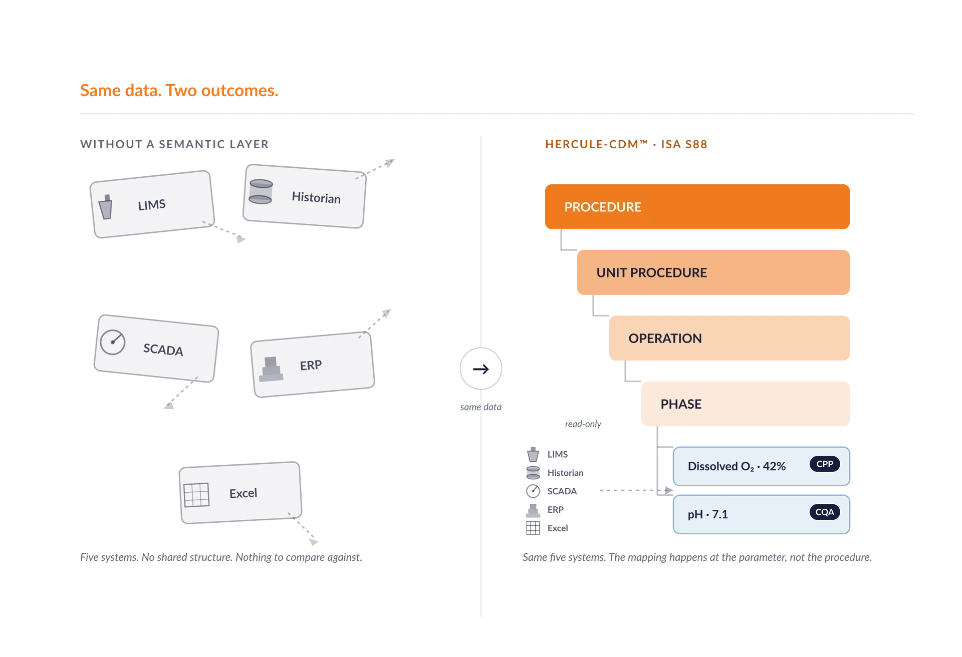
ISA S88 (IEC 61512) is the international standard for batch process control. It defines a precise hierarchy for describing manufacturing processes: a process is broken into unit procedures, which contain operations, which contain phases, each of which can carry one or more measured parameters. This hierarchy gives every data point a defined context — not just a value, but a position in the process that produced it.
In biomanufacturing, where a single batch touches a bioreactor, a centrifuge, a filtration skid, a LIMS, and an ERP, ISA S88 is the only common language that can unify those data sources without forcing them into a flat spreadsheet. When your data model mirrors the standard your process engineers already think in, every analysis becomes a question about process — not a data wrangling exercise.
Without a semantic layer, data is just noise with timestamps
Most biomanufacturing organisations hold years of valuable batch data — spread across a LIMS, a historian, a SCADA system, a QMS, and a folder of Excel files. The problem is not volume. The problem is meaning.
Without a shared data model, every analysis starts the same way:
- Weeks of data engineering to align naming conventions across systems
- Manual decisions about which parameters correspond across batches or sites
- No reliable way to know whether "DO" in your historian is the same measure as "dissolved oxygen" in your LIMS
- CPP and CQA classification locked in a Word document, invisible to any software
The result: your data scientists spend 80% of their time preparing data and 20% analysing it. Insights that should take hours take months — or never happen at all.
How Hercule-CDM™ structures your bioprocess data
1
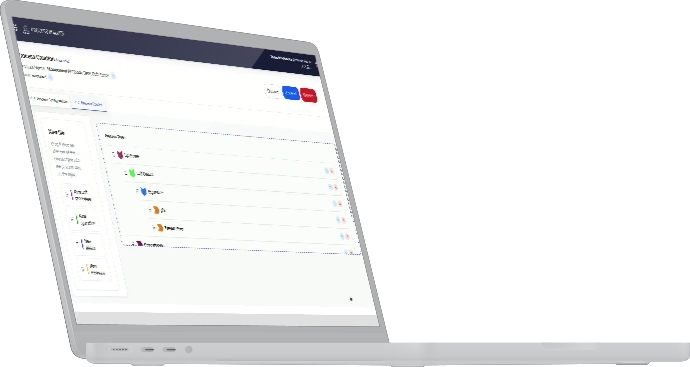
Define your ISA S88 process structure in Process Builder
Using Hercule's self-service Process Builder, your process scientist defines the unit procedures, operations, and phases that describe your process — directly in the platform, without spreadsheets and without waiting for IT. This typically takes minutes for a known process, not weeks.
2
Tag every parameter as CPP, CQA, or actionable
When a connector pulls a measure from your LIMS, historian, or SCADA, that measure is typed immediately: is it a Critical Process Parameter, a Critical Quality Attribute, or an actionable process indicator? This classification is not applied retroactively by a data team — it is embedded in the data model from the first ingestion.
3
Connect your data sources — Hercule reads, never writes
Read-only connectors pull data from your existing IT landscape. Hercule consolidates LIMS, ERP, SCADA, EMS, and historian data into a single structured warehouse. No changes are made to source systems. No data leaves your server.
4
Every dataset is immediately ML-ready
Because every parameter has a type, a position in the ISA S88 hierarchy, and a batch context, any downstream analysis — control charting, CPP-to-CQA correlation, golden batch benchmarking, multivariate modelling — can start immediately. There is no pre-work phase. There is no data engineering project before the first insight.
5
Historical data becomes a searchable asset
Once your process structure is defined, Hercule can back-populate the model with historical batches. Ten years of batch records that lived in disconnected systems become a unified, queryable dataset — ready for trend analysis, root cause investigation, or regulatory submissions.
Hercule-CDM™ — 200+ biomanufacturing concepts, already defined
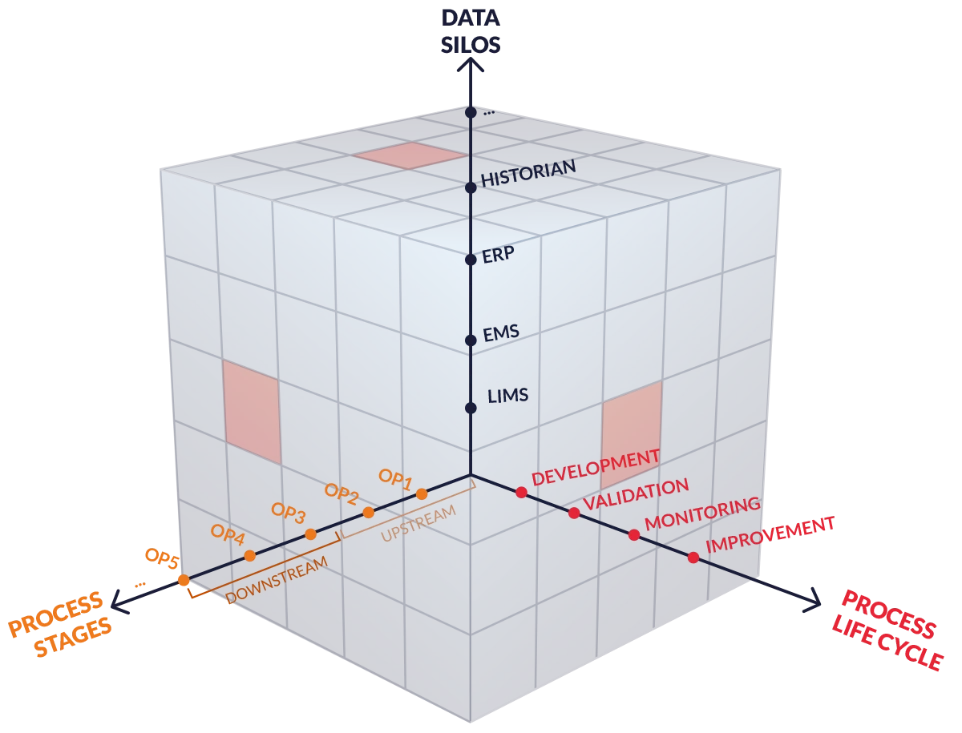
Building a data model from scratch is a research project. Hercule-CDM™ ships with more than 200 biomanufacturing concepts — covering upstream and downstream processes, analytical measurements, environmental parameters, and quality attributes — all pre-structured to ISA S88.
Your team does not define what "viability" or "osmolality" or "dissolved oxygen" means. Those concepts exist in the CDM. Process Builder lets you select and arrange them into the specific hierarchy that describes your process. You configure, you do not construct.
This means a new bioprocess can be fully modelled and ready for data ingestion in a single session — not after a months-long data governance initiative.
What parameter typing unlocks — CPP, CQA, and actionable, ...
CQA — Critical Quality Attribute.
- What it is: A physical, chemical, biological, or microbiological property that must be within defined limits to ensure product quality
- What Hercule enables : Direct CPP→CQA correlation analysis. Golden batch benchmarking. Regulatory dossier support. Multivariate modelling across batch history.
CPP — Critical Process Parameter.
- What is is: A process input or condition whose variability has a demonstrated impact on a CQA.
- What Hercule enables: Automated control charting, trend detection, OOS alerting in real time during batch execution. CPV programme live from the first batch.
Actionable.
- What it is: An indicator stating that operators can act upon the value of related parameter.
- What Hercule enables: Surfaced in dashboards and batch reports. Available for statistical analysis. Can be promoted to CPP or CQA as process knowledge matures.
Other categories of typing are also available, such as the nature of the data (environment, material, human factor, ...), the type of variable (textual, numerical, boolean,... ), the degree of the parameter (single-valued or time series, ...), ...
Three things that become trivial once your data is typed
Cross-batch parameter comparison
Comparing parameter X across 200 batches — different operators, different dates, different bioreactors — requires no pre-work. The semantic layer guarantees that every instance of that parameter is the same measure in the same process context.
CPP-to-CQA correlation
Because parameters are typed at capture, a correlation query between any set of CPPs and any CQA is a question you can ask in seconds. No data dictionary needed. No manual join. The relationship is already encoded in the model.
ML-ready datasets without data engineering
Every dataset exported from Hercule is already structured, typed, and labelled. A multivariate model, a digital twin, or a DoE analysis can start from the first export. Your data scientists analyse process — they do not reshape files.
Process Builder — define your ISA S88 structure yourself, in minutes
Hercule's Process Builder is a self-service interface for defining the ISA S88 structure of your bioprocess. No tickets to IT. No configuration sprints. No consultancy days billed to map your process.
Your process scientist opens Process Builder, selects unit procedures from the Hercule-CDM™ library, nests operations and phases, assigns parameters, and types them as CPP, CQA, or actionable. The structure is live and ready for data ingestion in the same session.
When your process changes — a new phase added, a new parameter introduced — you update the structure in Process Builder. The historical model is preserved. The new configuration is versioned. Nothing breaks.

Map your process with us, in 45 minutes
Bring your CPV strategy document, your process description, or just your questions. We will sketch your ISA S88 structure in Hercule live on the call — no preparation required on your side.
Frequently asked questions — ISA S88 and Hercule-CDM™
No. Hercule-CDM™ abstracts the standard into an interface your process scientists already understand: unit procedure, operation, phase, parameter. If you can describe your process in those terms — and most process scientists already do — you can configure Hercule. DNAlytics also provides onboarding support to map your first process with you during a structured 45-minute call.
Yes, and that is precisely the use case Hercule is designed for. Your CPV strategy document contains the process structure, the CPP and CQA classifications, and the control limits. DNAlytics uses that document as the input for your first Hercule configuration. What was static information in a Word file becomes an active monitoring structure in the platform — typically within weeks of starting.
Once your ISA S88 structure is defined in Hercule-CDM™, historical data from your connected systems can be back-populated into the model. Batches run years ago, stored in your historian or LIMS, become queryable against the same parameter structure as your current batches. This is how some of our customers surfaced a 15% productivity opportunity from ten years of existing data.
Yes. Hercule-CDM™ covers 200+ biomanufacturing concepts spanning upstream bioprocess (bioreactor, seed train), downstream purification (centrifugation, filtration, chromatography), formulation, and analytical measurements. Each process is modelled as a separate structure within the same platform — sharing the same CDM vocabulary and the same data warehouse. End-to-end analysis is a native capability.
Hercule is instrument-agnostic. It connects to your data source — whether that is a Sartorius historian, a Cytiva DeltaV system, a LabVantage LIMS, or a custom database — via a read-only connector. The instrument brand is irrelevant to the data model. One of our CDMO customer used Hercule with Ambr250 campaigns and reduced their bioprocess development timeline from 45 weeks to 28 weeks.
Hercule is developed to be validated against GAMP5 V2 and 21 CFR Part 11. The CDM structure, the Process Builder configuration, and all parameter classifications are version-controlled and audit-trailed within the platform. Changes to the process structure are logged with user, timestamp, and before/after state — meeting the documentation requirements for a validated GMP environment.